This week, we looked at some of the foundational myths of Japan, as well as information about early culture on the Japanese islands. As far as actual history goes, the first culture on the Islands was the Jomon culture. Among other notable features, the Jomon culture produced some of the world’s earliest pottery. After the Jomon came the Yayoi, who appear to have drawn a considerable amount from contemporary Korean cultures. In addition to importing goods and farming techniques from the Koreans, evidence suggests that Koreans were also immigrating to Japan during the period. One of the interesting developments was the visible increase in societal structure that occurred in this period. Tying into the reading from last week, we begin to see more hierarchy in the Yayoi period. Additionally, the Yayoi appear to have rapidly spread across Japan, expanding from their heartland in the southern and central parts of the country.
In addition to the actual history of Japan, we also looked at the creatin myth that was written down in 712. In addition to being an overall interesting story, it also brings up some interesting points about Japanese culture and gives us an opportunity to practice critical thinking about sources. For example, as a court document, how much might this differ from the beliefs of the common people, if at all? Or, could there be something in this that affirms the contemporary ruler’s power? Additionally, the text gives us an idea of what the Japanese were considering important enough to include in the creation myth, at least around 712. Something that I would be interested in knowing is how much people who are smarter and better trained than I can glean about beliefs and values from earlier periods from this text.
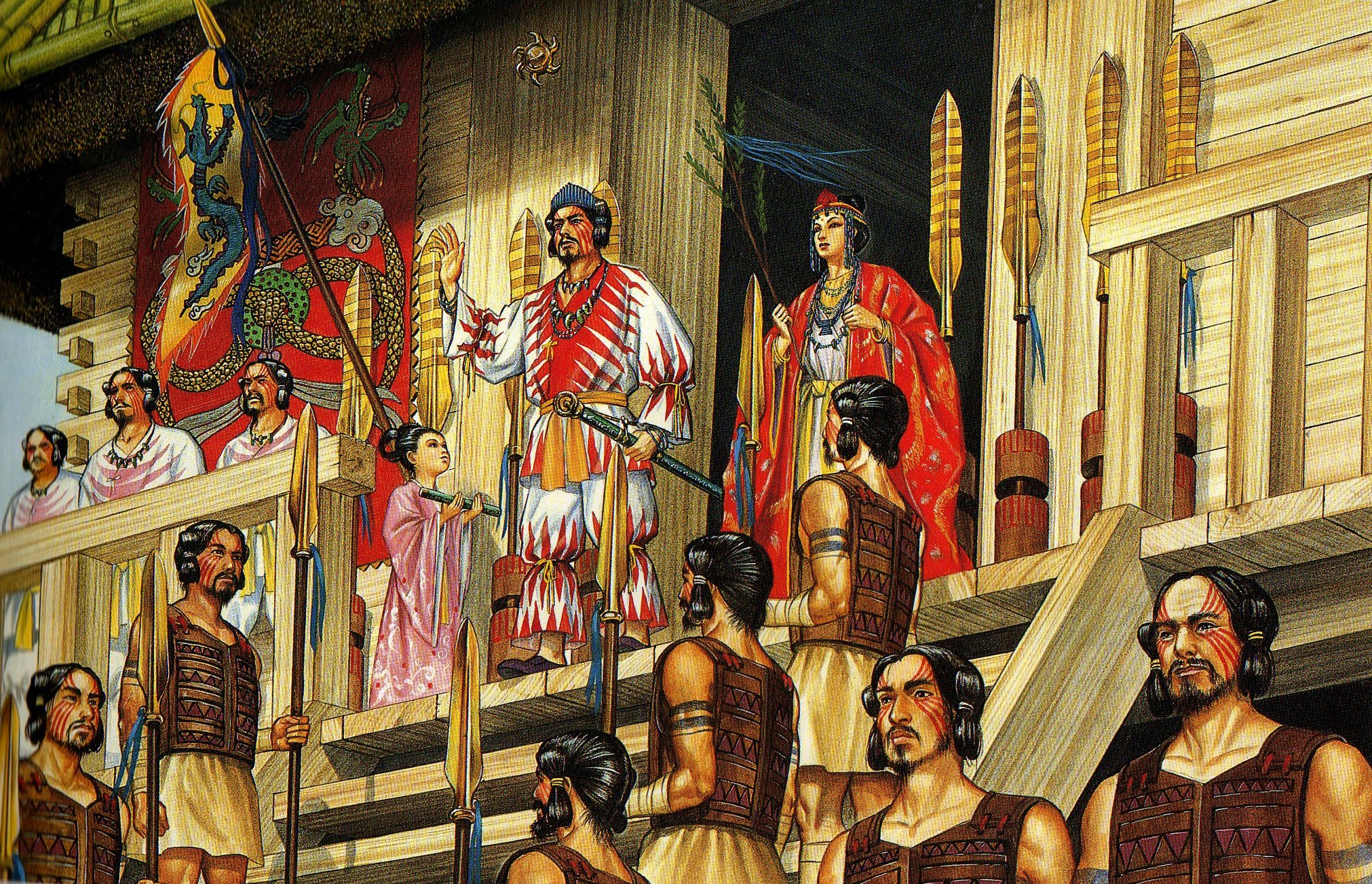
Friday’s group 2 reading about Queen Himiko was primarily just to familiarize us with what sources are good and what are to be avoided. However, the text was an interesting piece and laid out several points about early Japanese culture. First, that early Japanese monarchs (or at least some of them) derived their power from their shamanistic or priestly powers. Next, that the Japan of the third century CE was a country divided into many kingdoms, where one might gain temporarily some degree of power over at least some of the others. Finally, that women could, at least in some cases, become monarchs; one also wonders whether or how much record of Himiko could have been tampered with simply to increase or, more likely, decrease the impact of this fact.
Aikens, Melvin C. “Origins of the Japanese People.” In Japan Emerging: Premodern History to 1850, edited by Karl F. Friday. New York, NY: Routledge, 2018. https://muhlenberg.on.worldcat.org/oclc/787849954.
Shirane, Haruo. Traditional Japanese Literature: An Anthology, Beginnings to 1600. Abridged ed. Translations from the Asian Classics. New York: Columbia University Press, 2012.
Cartwright, Mark. “Queen Himiko.” World History Encyclopedia. https://www.worldhistory.org#organization, January 26, 2023. https://www.worldhistory.org/Queen_Himiko/.

Leave a Reply