This week, we looked at Mao Zedong’s Great Leap Forward, and some of the social implications of it. I misread the assignment for Wednesday’s class, and read both the Iron Child passage and the Lei Feng Diary. We discussed the Iron Child at length in class, but I had a few thoughts that I did not add during the discussion. The first of these was the fact that much of the realism of the story comes from the fact that one could imagine inventing a similar story to cope with the trauma that the author doubtless faced. It is very easy to imagine a person inventing the story about an iron best friend with whom one could feast on the massive amounts of metal everywhere, and that it was the fact that he had been so used to iron that he was repelled by food and by his parents. In a way, it makes sense as a nicer story to tell than to say that the author was abandoned, perpetually starving, and so poorly socialized that he ran from his parents when he first saw them. Of course, I am not suggesting that these were actually accurate depictions of part of the author’s past, but the fact that it is so believable that they are is part of what makes the story so compelling.
The diary of Lei Feng reads exactly like a toned down version of the fake soldier, Ogilvy, that Winston concocts in the book 1984. It makes me wonder whether the stories that came out about Lei Feng were changed in the same way that the Ministry of Truth changed Ogilvy’s life story. For example, since the poverty of the Great Leap forward was ongoing, the segment that we read was all about frugality. However, I wonder how much the stories changed when the order of the day was rooting out rightists, for example. One interesting difference between the Ministry of Truth’s fictional man and the CCP’s is that the whole point of Orwell’s man is to stand out, while the CCP’s encourages people to be part of the greater machinery of revolution. To me, this indicates an interesting nuance to the CCP propogandists that Orwell might have lacked. I also have to add that I find it amazing that there is debate about the authenticity of Lei Feng, since his diary is so completely aligning with party doctrine.
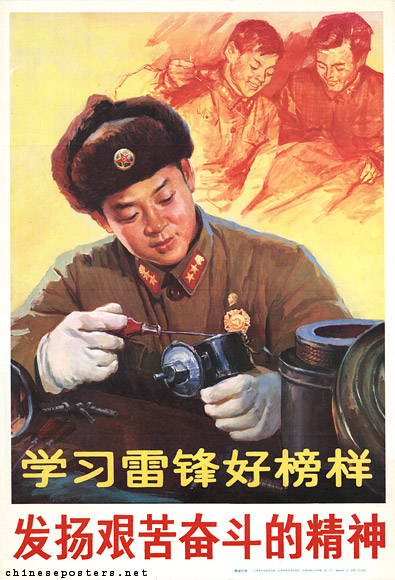
“Life and Death of Lei Feng, and Admirable ‘Fool’.” In The Search for Modern China: A Documentary Collection. Third ed. Edited by Janet Chen et. al. W. W. Norton & Company, 2014.
Mo Yan. “Iron Child”, in Shifu, You’ll Do Anything for a Laugh.

Leave a Reply