This week, we followed the collapse of the Ming, looking first at the general readings for Wednesday and then the conquest exploration pack. Probably the most extensive reading from this week was the Lovell reading, which went into some detail about the situation on the northern frontier at the time of the Manchu conquest. One of the most telling things that it highlighted was the sheer misery of deployments in the north; poor supply chains, poor leadership, and frigid winters all combined to make the life for Ming troops miserable. This in turn led to a low morale and poor performance. In describing the importance of Ming border fortifications, Lovell states that they were the only way that Ming troops were able to stand against the Manchu; I would be interested in knowing why that is. I know that Chinese armies in the past had managed to defeat steppe peoples in open battle, and I would have expected the Ming to be better supplied with more advanced weaponry. This might be a subject of interest for me to investigate later.
Another area that the readings for both Wednesday and Friday covered was commanders in the Ming army, particularly Wu Sangui. The Lovell reading paints a grim picture of life as a Ming commander, with defeat a sure way to be punished but victory no guarantee of safety. The northern commanders thus seemed to be in the unenviable position of having to face a skilled and determined enemy without motivated (or maybe even fit) troops and all the while knowing that any apparent loss could mean death at the hands of the court. All of this leads to the epidemic of defections that Lovell describes as happening as the Manchu advanced. The last Ming commander to defect, Wu Sangui, essentially let the Manchus into the Ming heartland. One of my ideas for a show and tell project is to look further into some of the pivotal commanders of the late Ming and early Qing such as Wu Sangui.
Two of the conquest pack of readings were primarily concerned with Qing enforcing their power on the Han people. The first of these documents was the edict that all subjects wear their hair in the Manchu style, and the second was an account of the Manchu sack of the southern city of Yangzhou. The second reading in particular left some questions for me. The biggest one was how Yangzhou fit into the wider conquest; for example, had they been under one of the three southern generals who rebelled, or had they simply never given up on the Ming?
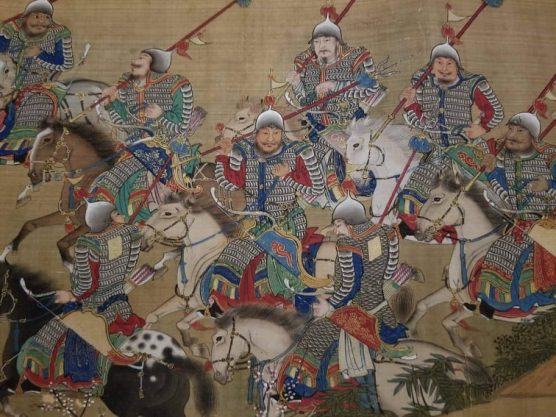
Carter, James. “The Untold Story of Wu Sangui, China’s Two-time Turncoat”. Supchina September 30. URL https://supchina.com/2020/09/30/the-untold-story-of-wu-sangui-chinas-two-time-turncoat/
Lovell, Julia. The Great Wall: China against the World, 1000 BC-AD 2000. 1st paperback ed. New York: Grove Press, 2007.
Struve, Lynn A. Voices from the Ming-Qing Cataclysm: China in Tigers’ Jaws. New Haven: Yale University Press, 1993.
“Nurhaci’s Seven Grievances”. In The Search for Modern China: A Documentary Collection. Third edition. Edited by Janet Chen, Pei-Kai Cheng and Michael Lestz, with Jonathan Spence, 19-21. New York: W.W. Norton and Co., 2014.
“Two edicts concerning hair”. In The Search for Modern China: A Documentary Collection. Third edition. Edited by Janet Chen, Pei-Kai Cheng and Michael Lestz, with Jonathan Spence, 19-21. New York: W.W. Norton and Co., 2014.

Leave a Reply