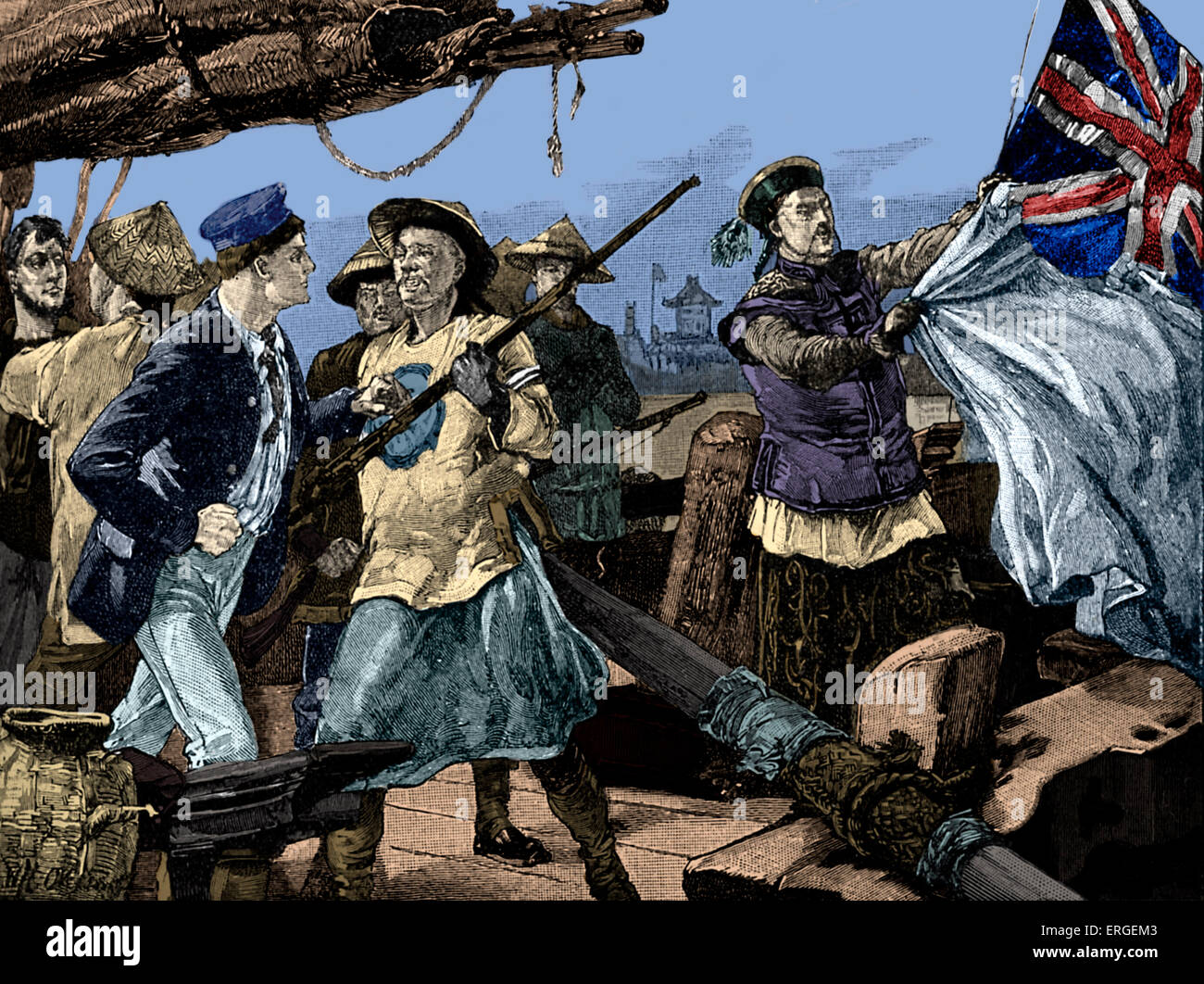
For Monday’s class, we read an article on the Opium Wars. These wars came about as the result of British attempts to find a way to create interest in China in trade, a problem that they solved by importing highly addictive opium into the country. The Chinese in return had to respond to the rampant drug abuse in their country, and did so by destroying British-owned opium. This led to a series of incidents which culminated in the British sending troops to China. In the ensuing war, the British massively outperformed the Chinese, eventually forcing them to sign a deeply humiliating treaty. The Chinese were naturally slow to enact the stipulations of the treaty which, along with attacks on Europeans in China, led to the second Opium War. This time, the French also joined in attacking the Chinese, once again crushing them and forcing them to sign another humiliating treaty. These defeats can be considered as the end of any Qing ambitions of world domination. The actual military events of the Opium Wars (or later Qing conflicts) would be a subject that I would be interested in covering for a show and tell.
One of the themes that I came away from this and the other readings was the cultural differences that made tragic encounters like the Opium Wars or the later Boxer Rebellion so likely. Both the Chinese and European ways of thinking about the world put themselves at the center, and the unwillingness of either to change their views made a bloody conflict, if not inevitable, then very likely. A clear example of the Chinese side of this way of thinking is the letter which the Qianlong Emperor sent to King George; this letter showed perfectly the Chinese view of themselves at the center of the world. Indeed, it showed it so clearly that British offense would be almost assured to follow.
I looked at the primary source exploration pack. If the Chinese were unwilling to see the Europeans as equals, they were at least partially interested in their culture. For example, the readings for Friday indicated that the Chinese had a great deal of interest in European scientific and mathematical advances, but not in the art of the West. That is, until the Jesuit painter Guiseppe Castiglione entered the Qing court and began to mix European and Chinese painting styles. The presence of Jesuits in Beijing is striking to me, since so few Europeans were allowed in the capitol, and I would be interested in a deeper history of the Jesuits in China.
“6.5: The Second Edict [from Qianlong to King George], Sept. 1793”. In The Search for Modern China: A Documentary Collection, edited by Janet Y. Chen, Pei-kai Cheng, Michael Elliot Lestz, and Jonathan D Spence, 90-93. Third ed. New York: W.W. Norton & Company, 2014. (PDF)
“Giuseppe Castiglione (Lang Shining, 郎世寧): A Jesuit missionary paints the emperor of China”. Obelisk. URL: https://arthistoryproject.com/artists/giuseppe-castiglione/
England and China: The opium wars, 1839-60. https://victorianweb.org/history/empire/opiumwars/opiumwars1.html.

Leave a Reply